

Biological overview
Appearance & anatomy: Saithe (also called coalfish) is a streamlined gadid with a dark, green-grey back, paler flanks, and a distinct, pale lateral line. The lower jaw is slightly protruding; barbel is absent compared to Atlantic cod. [1]
Size & lifespan: Individuals commonly reach 60–100 cm; large fish can exceed a meter and live more than a decade in northern waters. [1]
Habitat & distribution: A cool-temperate, shelf and slope species found from nearshore banks and fjords to several hundred meters depth. Juveniles frequent coastal areas; adults range widely across the Norwegian and Barents seas. [1]
Feeding & diet: Juveniles feed on zooplankton and small crustaceans; older fish shift to forage fishes (e.g., herring, capelin) and larger invertebrates. Shows strong schooling and active pursuit feeding in mid-water. [1]
Reproduction & early life stage: Spawning occurs from late winter into spring across banks and shelf breaks; eggs and larvae are pelagic before juveniles recruit to coastal nursery grounds. [1]
Juvenile vs. adult — the coastal-offshore shift
- Saithe show a pronounced ontogenetic habitat shift. 0+ to 2-year-olds aggregate in coastal fjords/kelp beds, where they form dense schools and feed in the water column. As they grow, sub-adults and adults redistribute to banks, shelf edges and slope habitats, often mixing with pelagic forage and following migration routes between feeding and spawning grounds. [2] This pattern underpins why you see small fish inshore and larger fish deeper/offshore in Norwegian waters.
Fishery
- The Northeast Arctic saithe fishery uses multiple gears with a strong demersal component. It’s taken by bottom trawls, gillnets, longlines and purse seines, with mixed-fishery interactions (e.g., with cod/haddock/golden redfish). Coastal small-boat fisheries also jig/handline saithe seasonally along banks and fjord mouths. [3]
Stock status & management
- Management: The management unit is saithe in ICES Subareas 1–2 (Barents & Norwegian Seas). The quota is national and set by Norway under its management plan. Russian catches are included in ICES catch totals/assessment, but Russia is not inside Norway’s quota. Moreover, no russian catch sampling data were available for 2021–2024.
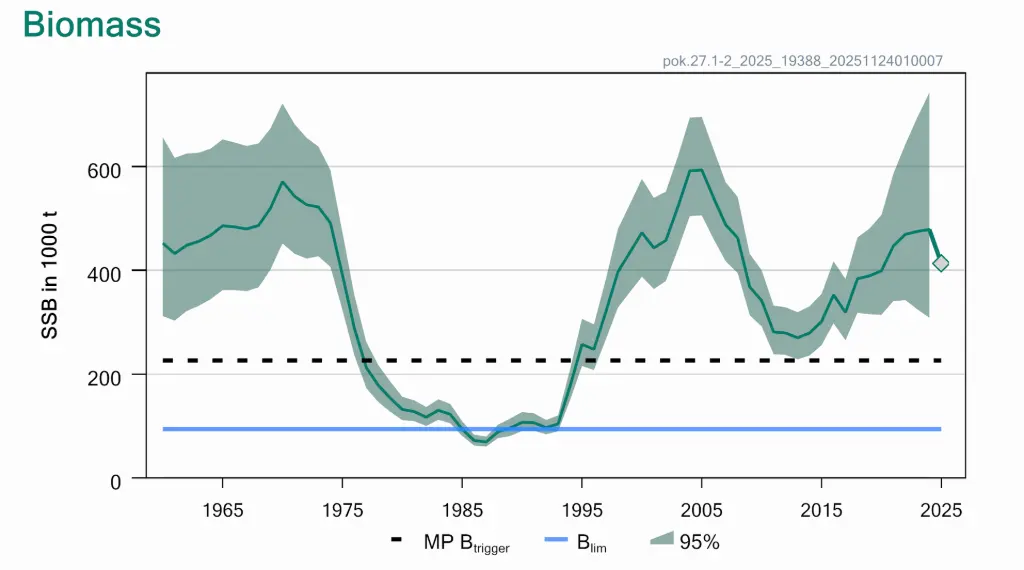
- Stock assessment: Arctic Fisheries Working Group (ICES-AFWG) estimated a fishing pressure close to the management-plan vlaue (FMP, dotted line) and below FPA (blue line), while SSB is above the management-plan biomass trigger (Btrigger, dotted line) and well above safety limit (Blim, blue line). [4]
- Advice for 2026: Applying the Norwegian management plan, ICES advises that catches in 2026 should be no more than 164,149. ICES also notes that bycatches of Norwegian coastal cod and golden redfish in the saithe fishery should be kept as low as possible. [4]



Fishing tips
- Where/Depth: Work reefs, ledges, and tide-swept channels from ~20–150 m. In fjords, target current pins and drop-offs; offshore, drift along bank edges where schools ride the slope.
- Metal jigs/pilkers: 60–100 g most days (150–200 g for depth/current). Lift–drop or fast lifts with brief pauses; keep the jig fluttering mid-water where saithe chase; add single assist hooks for cleaner releases.
- Topwater method: During summer–autumn when saithe push baitfish (small mackerel/herring) to the surface—often on strong tide runs, along edges, rips, or at dawn/dusk—you’ll see seabirds working and bait “spraying.” That’s your cue. The fjord is "boiling". Use 12–18 cm stickbaits, needles, WTD or poppers (≈30–80 g). Choose floating or slow-sinking. Long cast across or slightly uptide; fast “burn” with brief pauses, or walk-the-dog with occasional sweeps. Speed-up on followers.
- Tackle: 12–30 lb braid, 0.25–0.50 mm mono/fluoro leader; compact 6–7 ft rod for vertical work. Lighter tackle for better maneuverability and more fun during topwater action.
- Fish care (for C&R): To reduce post-release mortality, make sure your hands are always wet when handling fish. Keep fish low over the water, quick measure/photo, and use a descending device if brought up from >20/30 m to avoid barotrauma. [5] Watch for diving birds around surface feeds when fishing topwater.